Bullying in Schools Statistics: The Numbers Every Parent Should See
 By Mike Everett
The complete monitoring experience for your phone
Get XNSPY and start tracking calls, texts, multimedia, locations and more on any phone!
Get Started Now Live DemoYou may think that bullying is an old-school phenomenon, and that, with increased awareness, the bullying culture would have diminished. However, this is not the case. In fact, over the past few years, the numbers have increased significantly.
It is no longer limited to school corridors, school playgrounds, or after-school hours; it can also reach your children at home through the phones that have in their hands. Today, there are several kinds of bullying, and the impact has also become more drastic. Many anti-bullying organizations and even governments are conducting surveys and taking actions to control bullying in schools.
For parents, it is essential to understand the types of bullying and the extent to which it can affect their children. They can also examine how bullying manifests today and why early intervention matters. The data below highlights the scope of bullying in schools, the rise of cyberbullying, age-based trends, and the real impact bullying has on students’ well-being.
General School Bullying Statistics
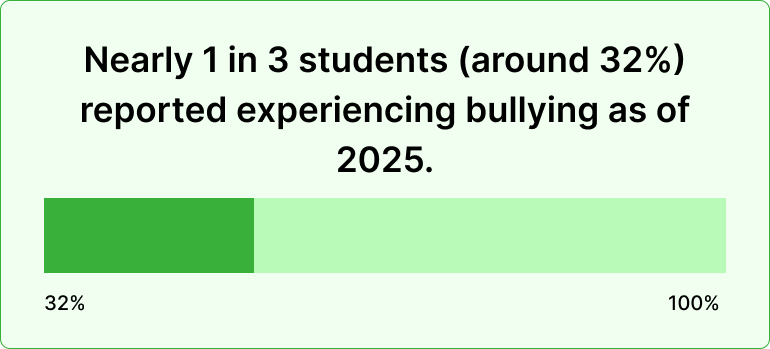
- Globally, nearly 1 in 3 students (around 32%) reported experiencing bullying as of 2025.
- In 2022, 1 in 5 students (19.2%) reported being bullied.
- 6% of young people experienced bullying daily.
- 9% reported being bullied once a week to once a month.
- Only 44% of students who were bullied at school reported the incident to an adult.
- Peers were present in approximately 85% of bullying incidents
- Less than 20% of the time, peers step in to protect
- When bullying is linked to personal characteristics, students reported being targeted most often for:
- Appearance: 32.7%
- Race: 13%
- Disability: 9.7%
- Ethnic origin: 9.4%
- Gender: 9.2%
- Sexual orientation: 8.9%
- Religion: 5.8%
- Where Bullying Most Commonly Occurs
- Classrooms 39.0%
- Hallways or Stairwells 37.5%
- Cafeteria 25.1%
- Outside (School Grounds) 24.4%
- Online or via Text 21.6%
- Bathrooms / Locker Rooms 11.9%
Check These Out

💣  Teen Dating Violence Statistics: Warning Signs & Trends
⚠️  89+ Phone Addictions Statistics You Should Know
🎰  51+ Video Game Addiction Statistics: Latest Numbers & Trends
⚡  99+ Teen Mental Health Statistics & Facts
Cyber-Bullying Statistics in Schools
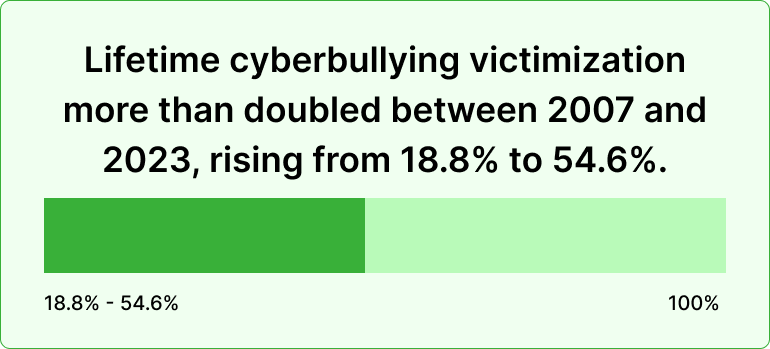
- Lifetime cyberbullying victimization more than doubled between 2007 and 2023, rising from 18.8% to 54.6%.
- Among students aged 12–18 who reported being bullied at school, 21.6% experienced bullying online or through text messages.
- The percentage of students aged 13–17 who have experienced cyberbullying at some point in their lives.
- Cyberbullying has increased from 18.8% in 2007 to 54.6% in 2023.
- The most commonly reported include:
- Mean or hurtful comments posted online: 30.4%
- Exclusion from group chats: 28.9%
- Rumors spread online: 28.4%
- Embarrassing or humiliating content shared online: 26.9%
- Adolescent girls were more likely to experience cyberbullying (28.6%) compared to boys (24.2%).
- How Youth Respond to Cyberbullying:
- Blocking the person responsible: 60.2%
- Telling a parent or guardian: 50.8%
- Ignoring the behavior: 42.8%
- Reporting the incident to the app or website: 29.8%
- Taking a break from electronic devices: 29.6%
Statistics of Bullying in Schools as per Age Demographics
- Students aged 10 to 15 are the most likely age group to be involved in online bullying.
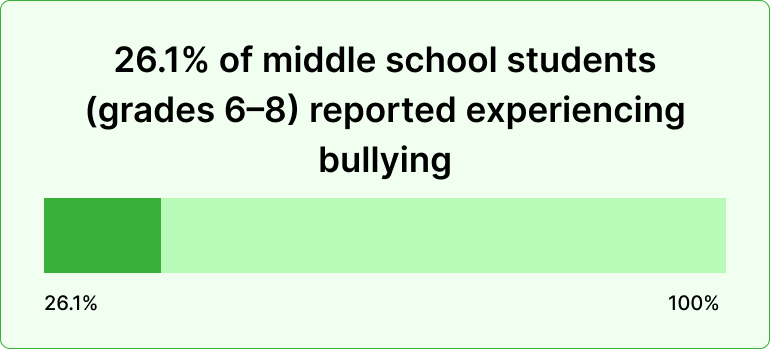
- 26.1% of middle school students (grades 6–8) reported experiencing bullying
- 14.6% of high school students (grades 9–12) said that they get bullied.
- Schools reporting cyberbullying incidents at least once a week showed clear differences by school level:
Elementary School (Ages 5–10)
- Approximately 10% to 11% of students aged 8–11 experience bullying at least once a week.
- Face-to-face interactions 14%
- social media 3%
- text-based bullying 5%
- About 10% of public elementary schools report bullying incidents occurring at least once a week.
Middle School (Ages 11–13)
- Roughly 26.1% to 27% of middle schoolers report being bullied.
- About 37% of middle schools report cyberbullying occurrences at least once a week—the highest of any school level.
- In middle school, peers are present in 85% of incidents
Bullying in High School Statistics (Ages 14–18)
- 14.6% to 19% of high school students report being bullied on school property.
- 16% to 18% of high schoolers report being bullied electronically.
College & Early Adulthood (Ages 18+)
- 20% of the student population over age 18 reports experiencing persistent bullying or harassment in university settings.
- One in five tweens (20.9%) reported having been cyberbullied, having cyberbullied others, or witnessing cyberbullying.
- 32% of Year 5 students reported frequent bullying at school.
- 29% of Year 8 students reported frequent bullying.
- Among older students, one in five pupils in Years 7 to 13 said they had been bullied within the past year.
Country-specific Statistics on Bullying in Schools
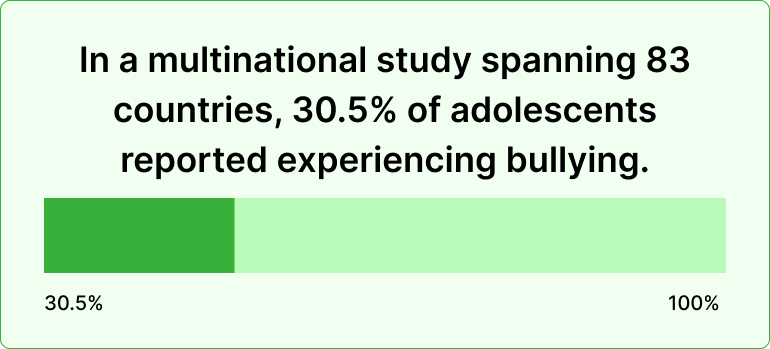
- In a multinational study spanning 83 countries, 30.5% of adolescents reported experiencing bullying.
- In Australia, approximately one in four students (27%) in Years 4 to 9 reported being bullied every few weeks or more often.
- The highest level of bullying was experienced in the Philippines. Roughly 76.6% of students report at least one incident of bullying in the past year, with 34.5% experiencing it weekly.
- The lowest was recorded in Japan and South Korea. These countries consistently report South Korea at roughly 1% to 5%. However, researchers note that “relational” bullying (social exclusion) is often higher but underreported due to cultural norms.
- 85% of students in India reported cyberbullying through digital or social media.
- 40% of students in the United Kingdom reported being bullied in the past year, mainly through name-calling or rumors.
- 19.2%–20% of students in the United States experienced bullying, primarily via rumors or verbal harassment.
- In the United States, 44.2% of students said they reported bullying to a trusted adult.
- 10% of students in Malaysia experienced verbal bullying, often including social exclusion.
- Between 5% and 22% of students in Singapore reported social exclusion, depending on the study.
- Recent studies (2025) show a slight decrease in traditional physical bullying in many Western countries, but an increase in cyberbullying across Asian countries and Australia.
The Impact of Bullying in Schools Statistics
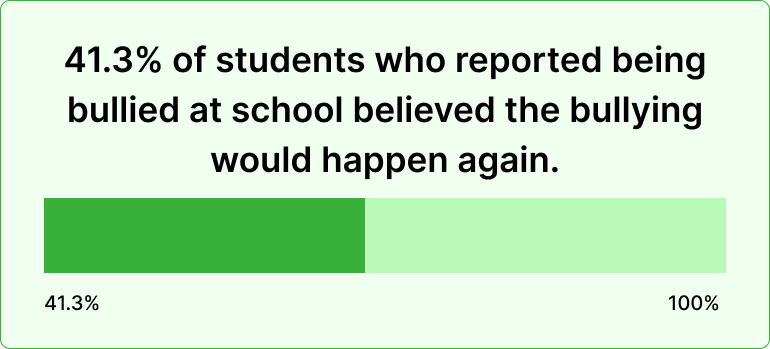
- 41.3% of students who reported being bullied at school believed the bullying would happen again.
- Youth who experienced cyberbullying reported negative impacts on:
- Feelings about themselves: 69.1%
- Friendships: 31.9%
- Physical health: 13.1%
- Schoolwork: 6.5%
- Students who are bullied are twice as likely to miss school or skip classes. Globally, it is estimated that over 160,000 students miss school every day primarily to avoid bullying.
- 24% of children who are bullied almost every day are also the most likely to be kept home from school by their parents.
- Victims of cyberbullying are 11.5 times more likely to report suicidal ideation, while victims of verbal bullying are 8.4 times more likely.
- The impact of bullying in school can last 40 years or more.
- Children who frequently bully others are 4 times more likely to engage in criminal behavior or have a criminal record by age 24.
- In the Philippines, researchers found that bullying-induced learning losses contribute to an annual economic loss of up to PHP 20 billion
Physical, Mental, and Relationship-Based Statistics Of Bullying In Schools
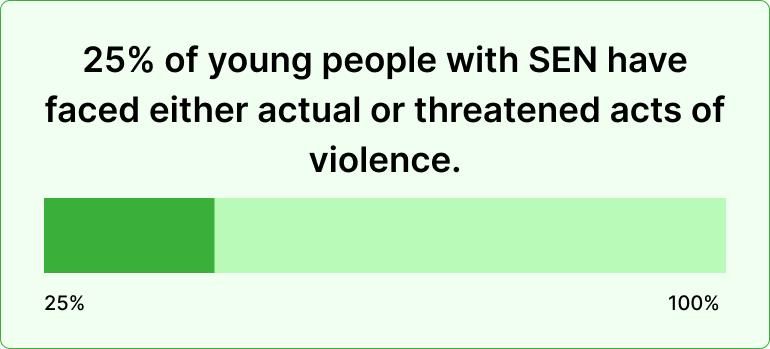
- 25% of young people with SEN have faced either actual or threatened acts of violence.
- Teenagers with a developmental disability were more likely to be bullied (44.4%) compared to those without a developmental disability (31.3%)
- LGBTQ+ students were more likely to be bullied at school (29%) compared to cisgender, heterosexual students (16%).
- Cyberbullying was also higher for LGBTQ+ students (25% vs 13%)
- 90% of LGBTQ+ students reported high emotional distress.
- Over 3 in 5 LGBTQ+ students experienced persistent sadness or hopelessness in the past year.
- More than half of LGBTQ+ students reported poor mental health in the past month
- Transgender, gender-diverse, and questioning students 54% reported high emotional distress.
- In similar groups without bias-based bullying, emotional distress rates were 20%–60% lower, averaging a 38.8% reduction
- Male students reported higher rates of physical bullying (6% vs 3.7%).
- Female students reported higher rates of rumors (16.6% vs 9.7%) and social exclusion (4.9% vs 2.6%).

Protect Your Child by Staying One Step Ahead
Download Xnspy and stay informed of what’s happening in your child’s digital world.
– See call logs, texts, and social media chats
– Track location in real time
– Get alerts on keywords or contacts
– Review complete browsing history
How to Prevent All Forms of Bullying in Schools: 4 Proven Ways
Bullying has the potential to push a child to suicidal thoughts. It should not be taken lightly by any party involved. The above school bullying statistics show that preventing bullying requires consistent effort from schools, parents, and communities. However, because most of the issues escalate, children hesitate to discuss with their parents. So parents have to take more proactive actions to ensure that children are not being bullied in school. Here are 4 ways to get started.
1. Use Xnspy Phone Monitoring App
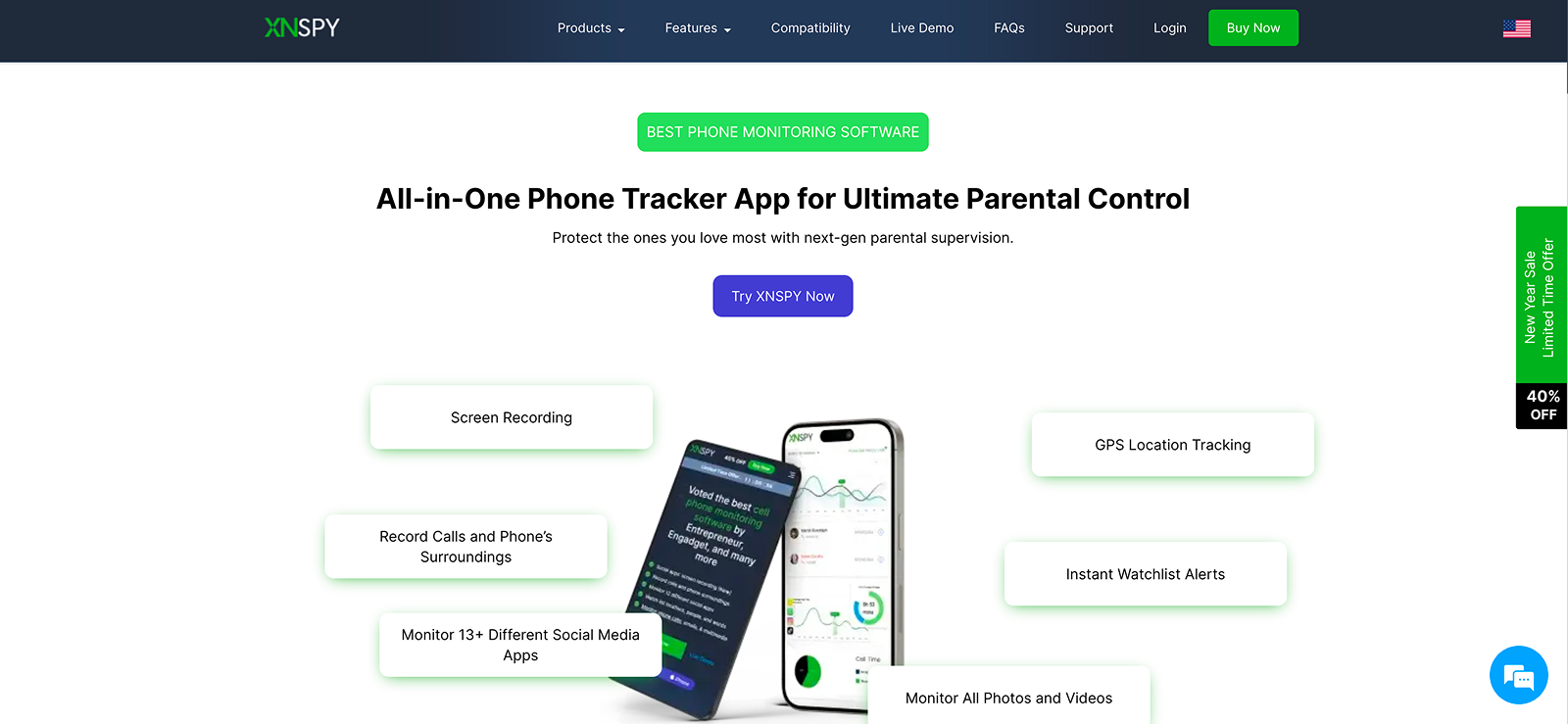
Xnspy is a parental monitoring app that tracks every phone activity of your children. From calls and messages to social media tracking, you can view with whom they are interacting and what they are experiencing online. As the bullying statistics in schools show that almost 54.6% adolescents experience cyberbullying, parents cannot ignore digital safety, and Xnspy can help them understand where the issue occurs.
To use Xnspy to protect your children from bullying, you have to install the app on your child’s phone. The app is straightforward to install and takes only a few minutes. Parents won’t even need technical knowledge to follow the instructions. Once installed, Xnspy hides itself, allowing you to monitor activities discreetly.
After installation, the app starts collecting the data and uploading it to the secure dashboard. All the activities are updated in real time, so if your child is being bullied online, you will know instantly and can intervene before the matter escalates.
To check whether your child is being abused online, you can use various features of Xnspy. First, the app allows you to view all SMS messages sent and received on the target device. You can go view the messages to ensure no one is sending threatening texts. Further, you can use the keylogger to know what they are typing.
This Xnspy feature enables you to view the messages they are sending and the online searches they are conducting. If they are replying to a bully, discussing their situation with a friend, or even searching the web, you can check using this feature. To receive instant alerts, you can add problematic words to the dashboard, such as bullying, hate, or ugly, so that whenever they are used, you will receive a notification, providing you with the complete context of the situation.
In addition, Xnspy tracks all popular communication channels like WhatsApp, Facebook, Telegram, and Instagram. You can go through the conversations to ensure your children are safe from cyberbullying. For more details, you can use Xnspy’s screen recorder feature, which captures screenshots of social media apps and allows you to view comments along with messages.
Xnspy not only ensures online safety but also helps you track your child’s physical location. You can use the Location tracking and geofencing features to identify patterns in school attendance or avoidance, which is often linked to bullying.
What makes tools like Xnspy useful is not control, but awareness. When parents have accurate information, they can initiate calm, supportive conversations rather than reacting after harm has already occurred. Used responsibly, monitoring tools can support timely intervention and help in reducing the percentage of bullying in schools.
Ensure a Positive School Climate
The above-mentioned statistics on bullying in schools clearly show that the numbers are increasing and impacting children in the worst way possible. Recently, schools have been taking many disciplinary actions to reduce the numbers; however, sometimes things get overlooked. In such cases, parents too need to be involved in the school activities. Ask children about their friends and the things they do with them.
Create a safe environment where they can share everything openly. Keep a good relationship with your child’s teachers and discuss their behavior in class and with their school friends. Teach your children to respect school premises, rules, and policies, and don’t take things too far while having fun. Clear rules, consistent consequences, and visible adult involvement help students understand that bullying is taken seriously.
Teach Social-Emotional Learning (SEL)
Social-emotional learning (SEL) is a framework that supports children in understanding their emotions, managing stress, building empathy, and forming healthy relationships. Through classroom activities, group discussions, and role-playing, students learn to resolve conflict, manage peer pressure, and respond to difficult situations without resorting to aggression.
When children are more open to understanding their emotions before projecting them onto others, they are more likely to resolve bullying situations independently. Also, they won’t hesitate to help their friends and won’t become bystanders. Improving children’s emotional awareness and peer respect directly affects statistics of bullying in schools.
Parents, too, can support SEL by practicing these lessons at home. They should encourage children to talk about feelings, model calm problem-solving, and discuss how to respond when someone is treated unfairly. When schools and families work together, SEL becomes a strong protective layer against bullying behaviors.
Keep Communication Open With Regular Check-Ins
Consistent communication helps parents spot early warning signs of bullying before the situation worsens. Have regular, low-pressure conversations, give children a chance to talk about their day, their friends, and anything that made them uncomfortable.
Instead of asking only whether school was “good” or “bad,” parents should ask specific, open-ended questions that invite detail. Also, discuss bullying directly and help them understand what is included and what is not. You can also show them bullying statistics in schools and help them understand what it actually is.
Conclusion
Statistics about bullying in schools can be used in various ways. They clarify what is included and what parents need to worry about. They make one thing clear: bullying is not a rare or harmless phase; it affects millions of students emotionally, socially, and academically.
From classrooms to digital platforms, children face risks that can leave lasting scars if ignored.
Additionally, the statistics on bullying in schools show that schools are not responsible for reducing bullying; parents, educators, and society all have to work together to help children protect themselves from the horrible experiences of bullying.
Sources
National Center for Education Statistics, 2022
National Bullying Prevention Center
National Center for Health Statistics
Youth Risk Behavior Surveillance System (YRBSS)
Children’s Hospital Philadelphia
Boston University School of Public Health
Journal of Social and Scientific Education 2025

4 Comments
Leave a reply:
Your email address will not be published. Required fields are marked*


John Carlos
February 4, 2026 at 2:50 pmI sometimes see people say that cyberbullying is far worse than traditional bullying which pissed me off so much because I have seen my son come home with scratches and bruises. Nothing compares to the pain you feel.
Leonardo
February 9, 2026 at 1:47 pmIt just feels like no one cares enough about bullying because after it is not the gov officials' kids that are dying from it :)
Jenny
February 11, 2026 at 12:26 pmToo triggered, as someone who has suffered from bullying, I am afraid for the generations to come.
Juniper Raymond
March 30, 2026 at 1:58 pmCan you cover stats on cyberbullying too please?