20+ Dangerous Social Media Challenges Parents Should Know About
 By Jenny Nicole
The complete monitoring experience for your phone
Get XNSPY and start tracking calls, texts, multimedia, locations and more on any phone!
Get Started Now Live DemoEditorial note: This article is intended for parental awareness and prevention. It does not provide instructions for attempting any stunt.
Social media can give teenagers friendship, creative expression, humor, and a sense of belonging. But simultaneously, it can also turn a reckless idea into a public performance within hours.
But the question persists: how to stop children from participating in dangerous social media trends?
Well, as a mother of two teenage daughters and a specialist in adolescent digital behavior, I have learned that fear-based lectures are not the way to go since they do not target the reasons a teen participates.
Therefore, for parental guidance, this blog explains 24 recent dangerous online challenge examples, the psychology behind them, and what parents can do without turning every conversation into an interrogation.
Brief Version for a Quick Look
- Viral challenges can cause burns, poisoning, choking, head injuries, legal trouble, and even death.
- Teens often participate for belonging, attention, curiosity, identity, or peer approval—not simply because they ignore the danger.
- Social media videos distort risk by showing successful attempts while hiding injuries, failed takes, and emergency treatment.
- High-risk trends may involve restricted breathing, medications, inhalants, fire, weapons, dangerous food stunts, or deliberate injury.
- Parents should begin with calm, curious questions rather than accusations, threats, or fear-based lectures.
- Clear family rules and rehearsed refusal lines can help teens exit risky situations without losing face.
- The goal is not to track every trend, but to build a teen’s judgment, confidence, and willingness to pause before participating.
How Dangerous Social Media Trends Become Mainstream
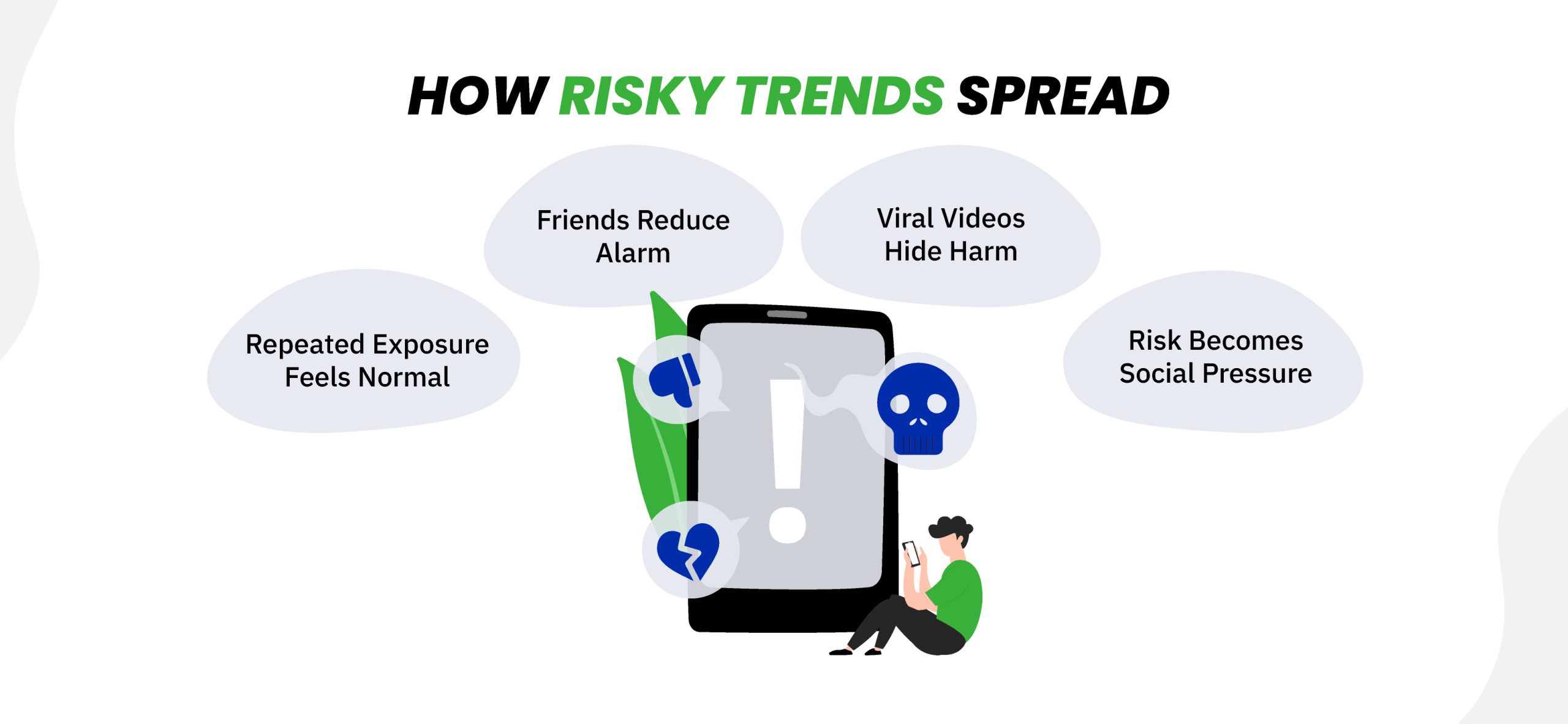
Viral participation usually grows through repetition rather than persuasion. When a teenager sees the same behavior performed by friends and creators, familiarity lowers their emotional alarm. The result is simple: the act begins to feel less like a dangerous decision and more like a shared cultural moment.
Not only that, but the visibility of social media challenges also creates a distorted picture of risk. Children mostly see videos that end without visible injuries since they are more likely to be posted by a fellow social media user.
Contrarily, failed attempts, emergency treatment, family distress, and long recoveries are far less likely to appear in their feed.
And this is how dangerous trends on social media can become normalized before parents and platforms even realize they exist.
Dangerous Social Media Challenges Statistics: What Parents Should Know
It is difficult to say exactly how many teenagers take part in social media dangerous challenges since there is no worldwide database tracking every trend, platform, injury, or participant.
However, researchers have found clear evidence that these challenges can cause serious harm.
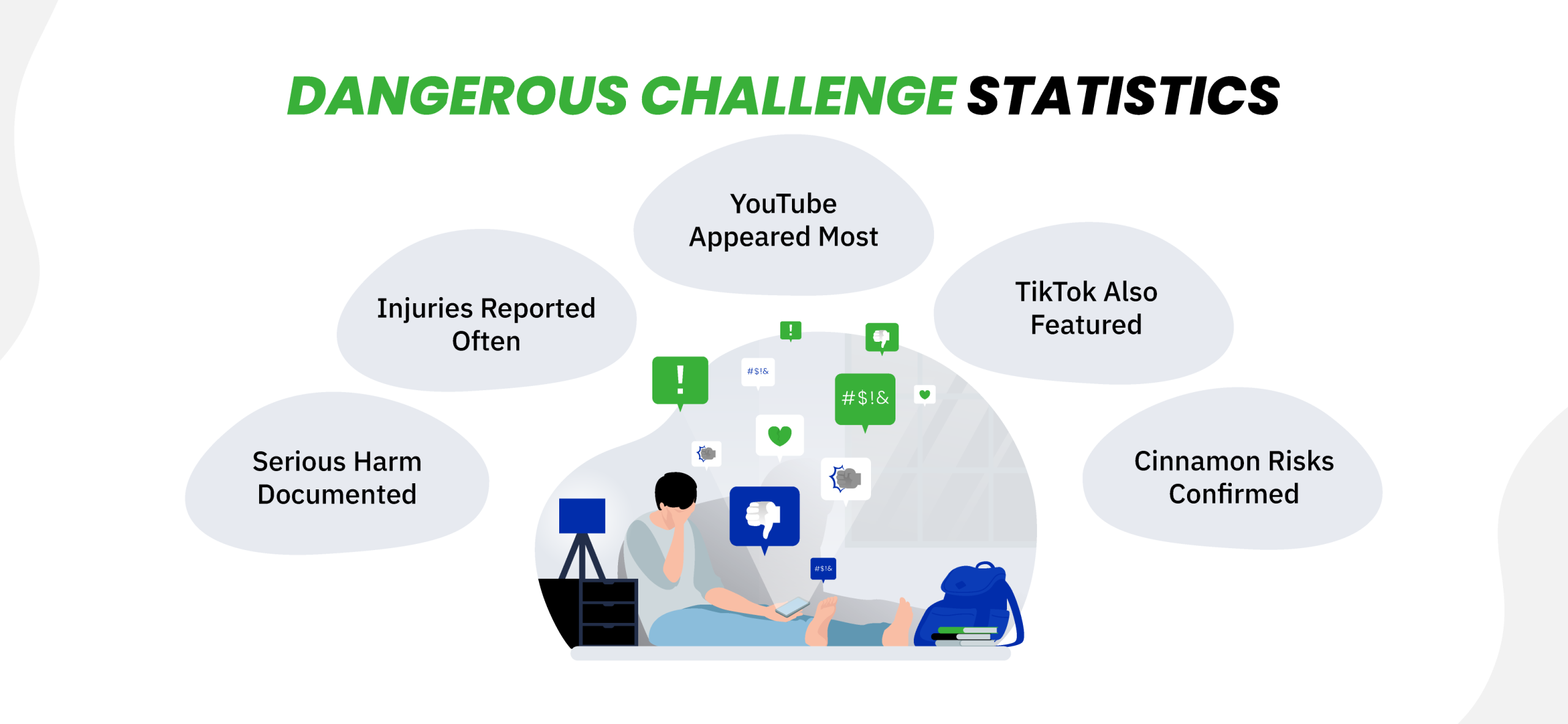
For example, a review examined 54 published articles covering 48 different online challenges. Within these articles, injuries were discussed in 89% of the articles, and reported consequences included emergency hospital visits, permanent health problems, and death.
The researchers also found that:
- YouTube appeared in 52% of the studies.
- TikTok appeared in 31% of the studies.
- Reported injuries included burns, poisoning, lung damage, strangulation, and head trauma.
A Note on the Cinnamon Challenge
Parents looking for an exact fatality figure associated with the cinnamon challenge death count should know there is no count for this specific trend. Still, medical literature and poison-center reports clearly document choking, aspiration, lung injury, emergency visits, and hospitalization.
Here Are Some Blogs You Shouldn’t Miss

💣  Dangerous TikTok Challenges Every Parent Should Be Aware Of
🚑  99+ Teen Mental Health Statistics & Facts
⚠️  27+ Most Dangerous Apps for Kids: Names, Dangers, and Alternatives
💸  15 WhatsApp Scams You Didn’t Know About + How to Prevent Them
Dumbest Challenges on Social Media
The label “dumb” here describes the poor risk-to-reward calculation, not the intelligence of the young person involved. Many of these challenges exploit an ordinary object or seemingly simple pose, which makes the danger easier to underestimate.
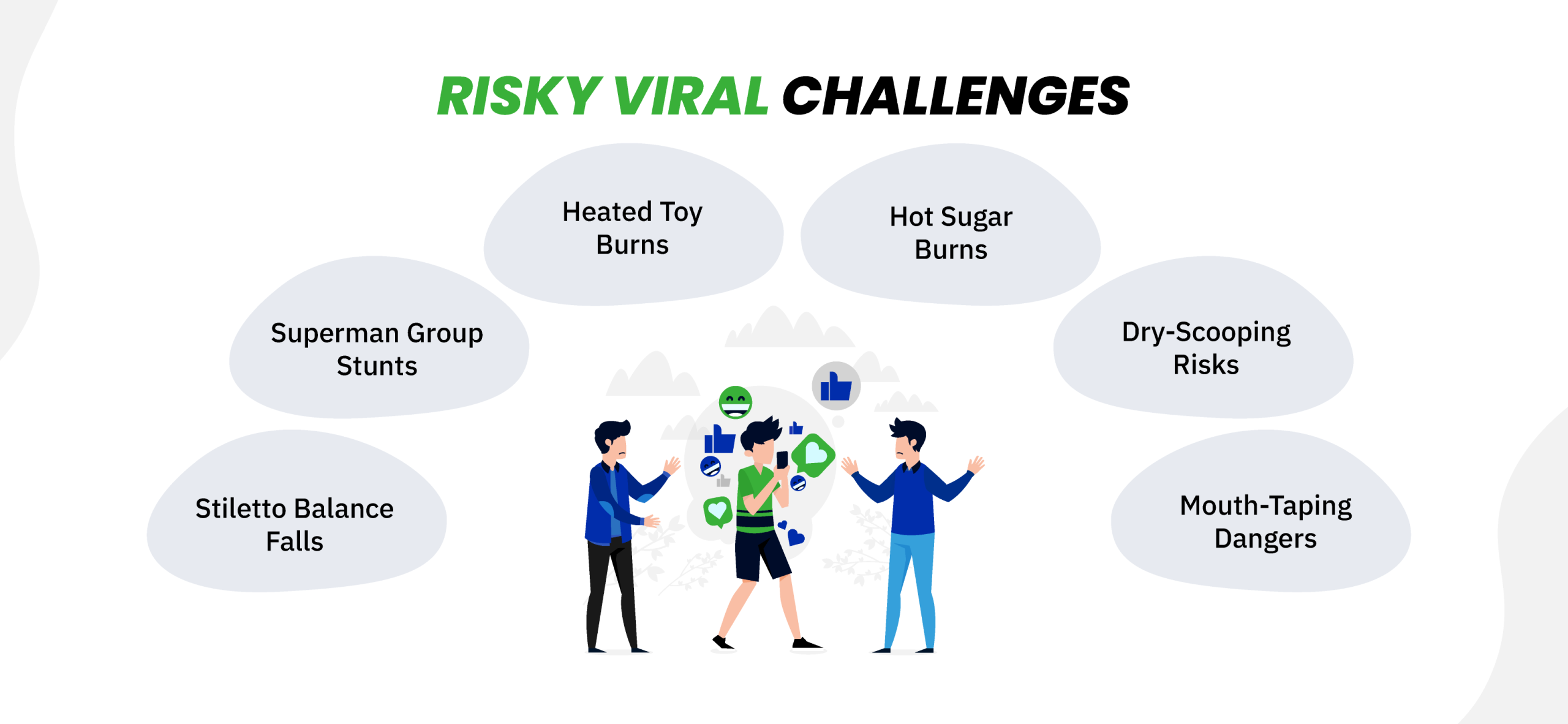
1. The Stiletto Challenge
The Stiletto Challenge gained attention in 2025 as users attempted an unstable high-heel balancing pose inspired by a music-video image. One attempt even ended in a spinal compression injury after the participant fell backward.
For this particular challenge, the psychological hook is its visual status since the pose looks glamorous when completed successfully. Therefore, for teenagers, it can feel like a test of balance and aesthetic control rather than a fall hazard.
Main risks: Spinal injury, concussion, wrist fractures, ankle injury, and falls onto nearby objects.
2. The Superman Challenge
This group stunt spread internationally in late 2024 and continued appearing in school-age peer groups.
To partake in the trend, participants attempt to launch or catch another person in a “flying” pose.
The result? Hospitals reported fractures, head injuries, loss of consciousness, and surgeries.
Even with the risks, the challenge is particularly appealing because it requires friends, and the group involvement makes each participant feel like nobody is individually choosing the risk.
Main risks: Head trauma, facial injury, broken limbs, dental injury, and spinal damage.
3. The Microwaved Sensory-Toy Trend
In early 2026, burn specialists warned after children heated gel-filled sensory toys to make them softer. In one documented case, the toy burst and hot material stuck to a nine-year-old’s face.
To add to it, the danger is hidden because the object is marketed as a toy. Children may assume that something safe to squeeze is also safe to heat.
Main risks: Deep facial burns, eye injury, scarring, and burns to the hands or airway.
4. The DIY Tanghulu Trend
Tanghulu, fruit coated in hardened sugar, became a highly visual home-cooking trend. For this particular trend, the concern is not the food itself but the unsupervised handling of extremely hot, sticky sugar.
Shriners Children’s Boston reported treating multiple young patients with serious burns as the trend continued.
In case of a mishap, sugar adheres to skin and allows heat to remain in contact with it longer than a quick splash of water.
But videos tend to hide the hazards by compressing the preparations into a few satisfying seconds.
Main risks: Second- and third-degree burns, scarring, and hand or facial injury.
5. The Dry-Scooping Challenge
Dry scooping is one of the dumbest challenges that involves consuming powdered workout products without preparing them as directed.
In reality, this behavior has no proven performance benefit and can lead to aspiration, airway inflammation, breathing problems, and stimulant-related cardiac effects.
Main risks: Choking, powder aspiration, breathing difficulty, rapid heart rate, high blood pressure, and stimulant toxicity.
6. The Mouth-Taping Sleep Challenge
Mouth taping has circulated through wellness and appearance-focused feeds, with claims that it improves sleep and facial definition, but these claims lack adequate evidence.
Not only that, but restricting mouth breathing can also be dangerous for people with nasal obstruction, sleep apnea, or other airway problems.
Parents should know that what makes this trend compelling is that it promises improvement during sleep, without any visible effort or embarrassment.
Main risks: Restricted airflow, panic, disrupted sleep, delayed diagnosis of sleep apnea, and possible asphyxiation in vulnerable users.
Life-threatening Social Media Challenges
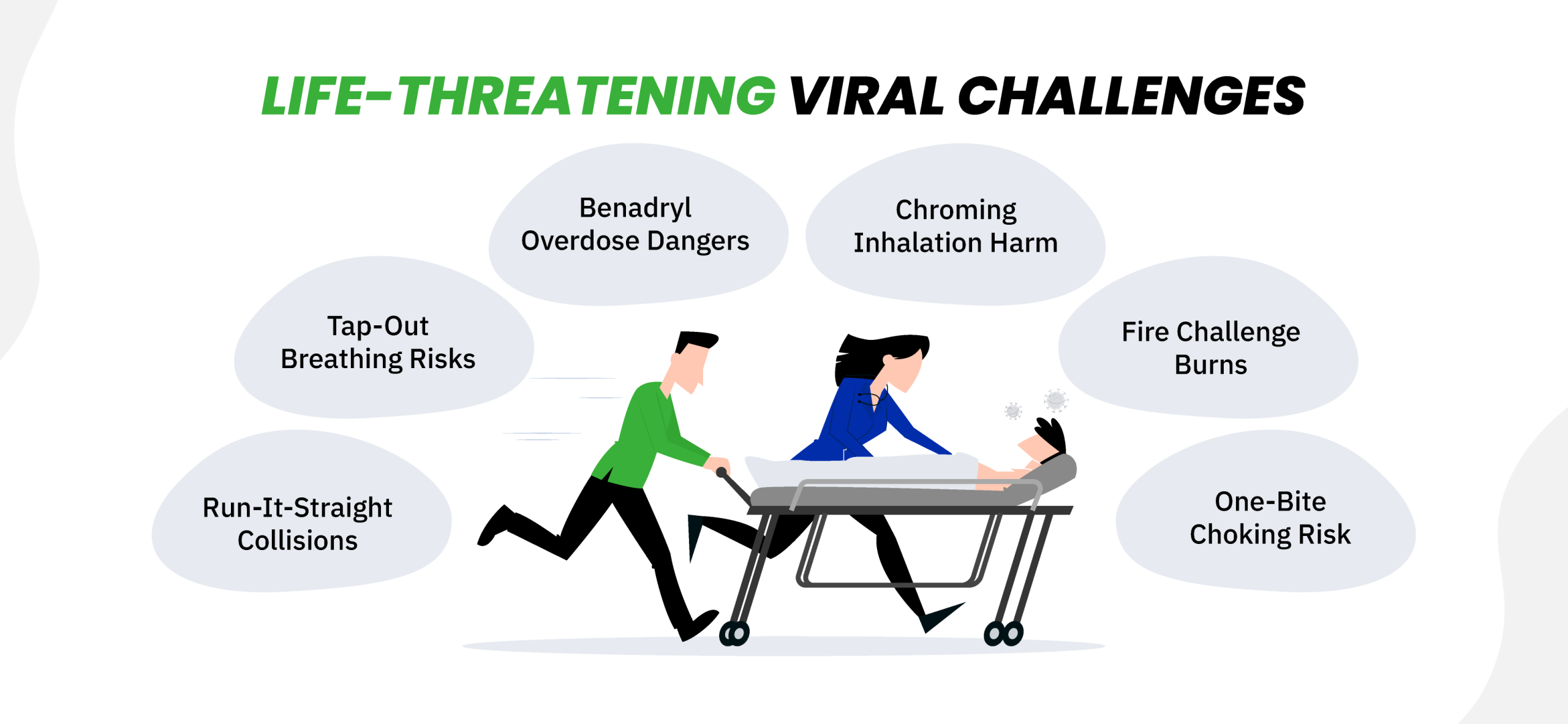
The following are among the most dangerous social media challenges because a single attempt can cause catastrophic injuries.
7. Run It Straight
The Run It Straight trend is a combat-style contact game in which a ball-runner and a defender sprint directly at each other for a full-body tackle. The goal is to dominate the impact without sidestepping, ducking, or hurdling.
In May 2025, a 19-year-old in New Zealand died after sustaining a serious head injury during a game linked to the viral trend.
Main risks: Traumatic brain injury, internal injury, spinal trauma, loss of consciousness, and death.
8. The Tap Out Challenge
The Tap Out Challenge involves restricting breathing until someone loses consciousness or signals that they cannot continue. Children were also warned against it after a 16-year-old was hospitalized with a fractured skull and serious injuries.
Main risks: Oxygen deprivation, seizures, brain injury, cardiac arrest, falls, and death.
9. The Benadryl Challenge Resurgence
The Benadryl Challenge has repeatedly resurfaced and encourages the misuse of diphenhydramine in pursuit of hallucinations or dramatic reactions. Note that excessive doses can cause serious heart problems, seizures, coma, or death.
Main risks: Delirium, abnormal heart rhythm, seizures, coma, and fatal poisoning.

When Trends Turn Toxic, You’ll Know First
Xnspy keeps you updated before things spiral.
10. Chroming
Chroming refers to deliberately inhaling fumes from household or industrial products for a brief intoxicating effect. The behavior has circulated through short-form videos and has been linked to fatal incidents involving adolescents.
Main risks: Sudden cardiac arrest, oxygen deprivation, seizures, brain injury, chemical burns, organ damage, and death.
11. The Fire Challenge Resurgence
Fire-based stunts have resurfaced in multiple forms, including videos involving flames, flammable liquids, or burning patterns on surfaces. The result of partaking in such trends can be severe burn injuries from fire-based online stunts.
Main risks: Deep burns, inhalation injury, house fires, permanent scarring, and death.
12. The One-Bite Food Challenge
The One-Bite trend encourages users to force an unusually large portion of food into the mouth at once.
Main risks: Complete airway obstruction, aspiration, loss of consciousness, and death.
These examples show why lists of the most dangerous social media challenges must be updated carefully since some older stunts disappear, while others return under a new name.
Harmful Social Media Trends
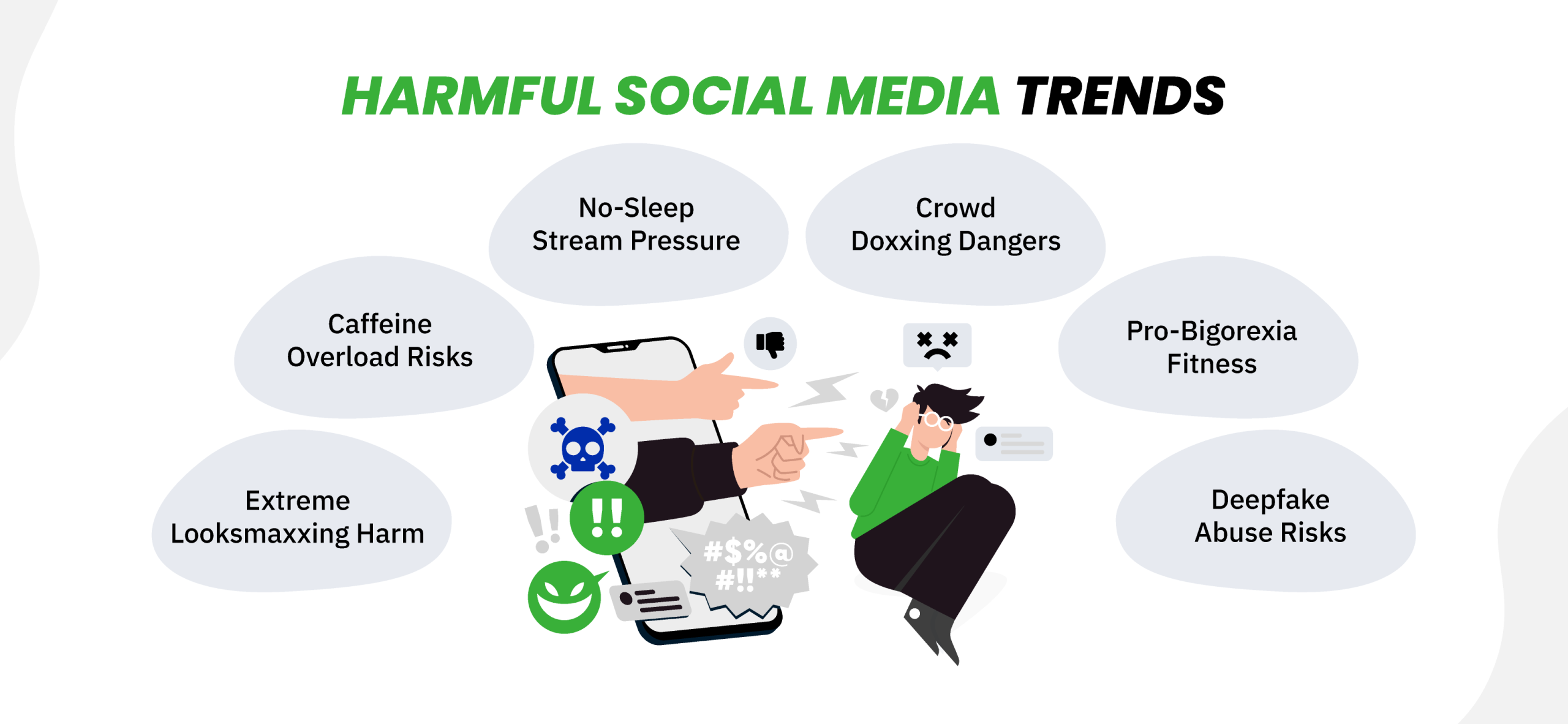
Not every risk arrives as a single dare; some behaviors spread as lifestyles and beauty systems. These trends can affect a teenager gradually by shifting what feels normal, attractive, funny, or socially acceptable.
13. Bone Smashing and Extreme Looksmaxxing
Bone smashing is an appearance-focused practice promoted in some looksmaxxing communities. It encourages repeated blunt trauma to the face based on the false idea that injury will create a sharper jaw or cheekbones.
But the result can often be fractures, nerve damage, dental problems, scarring, and permanent disfigurement.
14. Caffeine Stacking and Energy-Product Overload
Fitness and study-content creators sometimes encourage teenagers to combine energy drinks, caffeine shots, powders, and supplements to stay awake.
However, taking several caffeine products together can expose the body to far more caffeine than expected.
And teenagers may be particularly vulnerable because this trend reflects a wider online culture that treats exhaustion as a weakness and promotes stimulants as a shortcut to better performance.
15. No-Sleep Livestreams
In no-sleep streams, creators broadcast extended periods of wakefulness while viewers comment and donate. The format turns exhaustion into entertainment and makes stopping feel like disappointing an audience.
However, what many do not realize is that sleep deprivation can impair judgment, emotional regulation, reaction time, and impulse control.
16. Crowd-Identification and Doxxing Trends
Posts using phrases such as “TikTok, do your thing” sometimes invite users to identify a stranger from a photo or brief public encounter. Upon studying 60 such videos with 1901 comments, it was found that 19 of those people were successfully identified.
In such instances, the crowd may view the search as collaborative detective work. The trend raises concerns about consent, stalking, surveillance, and unwanted content.
17. Pro-Bigorexia Fitness
One of the many harmful social media trends also includes how some fitness content encourages teenage boys to believe they are never muscular enough. Instead, risky eating, exercise, and supplement habits are presented as discipline and “grinding.”
This trend can be difficult for parents to spot because a teen may not describe it as a body image problem. Instead, they may talk about improving their physique or refusing to be weak.
Warning signs may include exercising despite pain or injury, skipping meals, avoiding family activities, becoming highly critical of their appearance, or using multiple supplements without professional guidance.
18. AI-Generated Sexualized Deepfake Abuse
AI “nudify” tools and image generators have made it easier for students to create or circulate fake sexualized images of classmates. Although this is not conventionally one of those dangerous challenges on social media, it can spread through peer groups as a dare or joke.
For such cases, while the image is fabricated, the humiliation and social consequences are real. Therefore, victims may experience anxiety, school avoidance, loss of trust, harassment, and fear that the image will continue circulating.
Dangerous Social Media Pranks
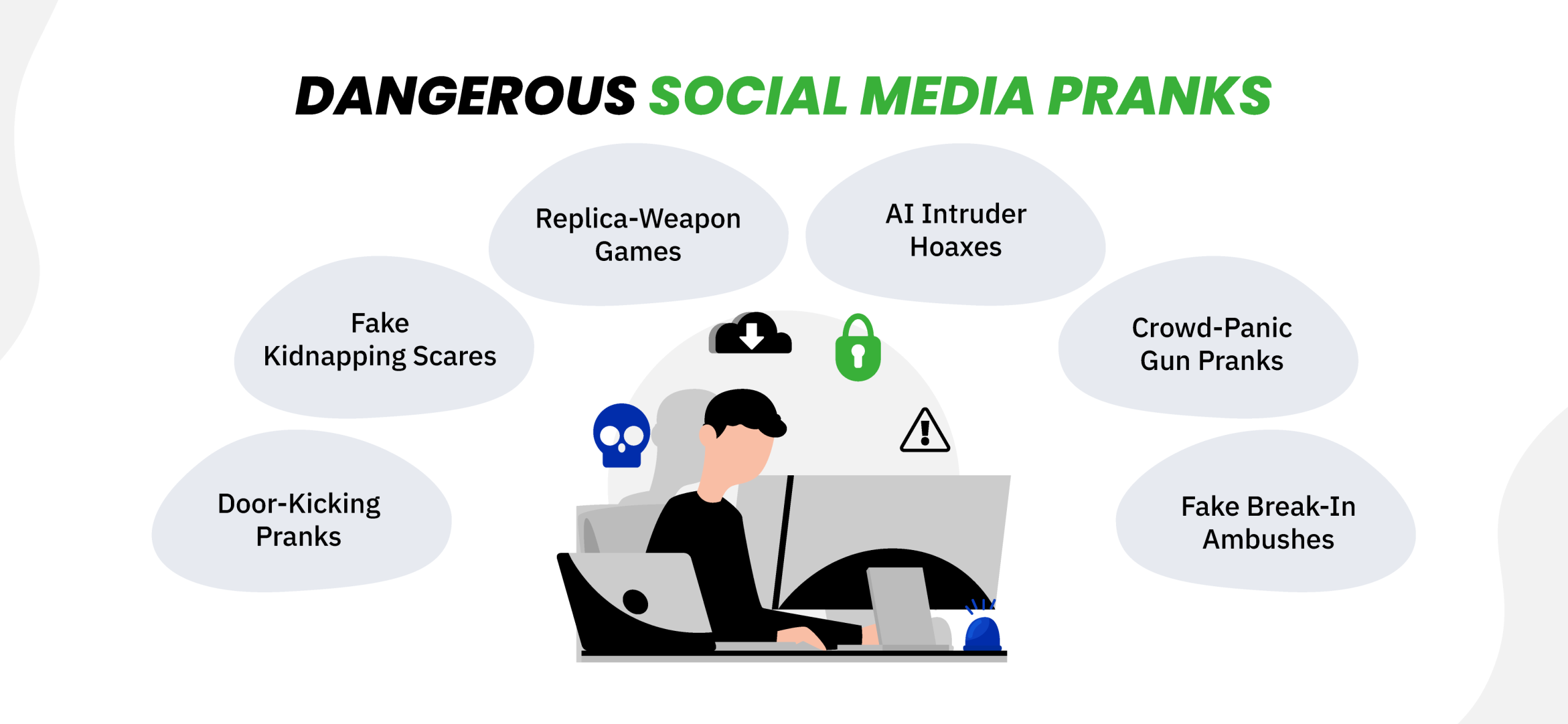
Prank content becomes hazardous when the target cannot distinguish performance from a real threat.
19. The Door Kick Challenge
The Door Kick Challenge escalated across U.S. communities in 2025 and continued prompting police warnings into 2026. To partake in the challenge, participants violently kick or pound on residential doors and flee while filming.
Main risks: Violent confrontation, criminal charges, injury, property damage, and trauma to residents.
20. The Fake Kidnapping or Candy-Lure Prank
In May 2026, Florida authorities investigated a report involving a vehicle following a school bus and someone offering candy to a student. It was later found out that two teenagers were participating in a TikTok prank.
Main risks: Police intervention, panic, confrontation, criminal investigation, and emotional harm to children and families.
Xnspy Packs More Features Than Any Other App
From chats to location, we track it all – live.
21. Senior Assassin With Replica Weapons
Senior Assassin is an end-of-school game in which students try to tag assigned targets, commonly with water guns.
Note that the game is not inherently malicious, but some kids go as far as using realistic-looking devices, ambushing the other person, trespassing, and wearing masks.
Main risks: Mistaken-weapon reports, armed responses, trespassing charges, and vehicle accidents.
22. The AI “Intruder” or “Homeless Man” Prank
This 2025 trend used AI-generated images to make it appear that an unknown person was inside a family home. In response, some recipients called emergency services.
Main risks: Emergency deployments, dangerous misunderstandings, false-report charges, family distress, and dehumanization of unhoused people.
23. The “He Has a Gun” Crowd-Panic Prank
By far, one of the most dangerous social media pranks is students shouting in crowded areas of school that someone has a gun to record others’ reactions.
Even when no weapon exists, during panic, people may run, fall, fight, or call armed responders.
Main risks: Stampede injuries, panic attacks, police escalation, school discipline, and criminal charges.
24. Fake Break-In and Replica-Gun Ambush Videos
A more extreme variation of home-targeting content involves masks, simulated break-ins, and realistic-looking replica weapons to replicate a break-in.
Main risks: Shootings, arrest, property damage, retaliatory violence, and long-term legal consequences.
The Negative Effects of Dangerous Trends on Social Media
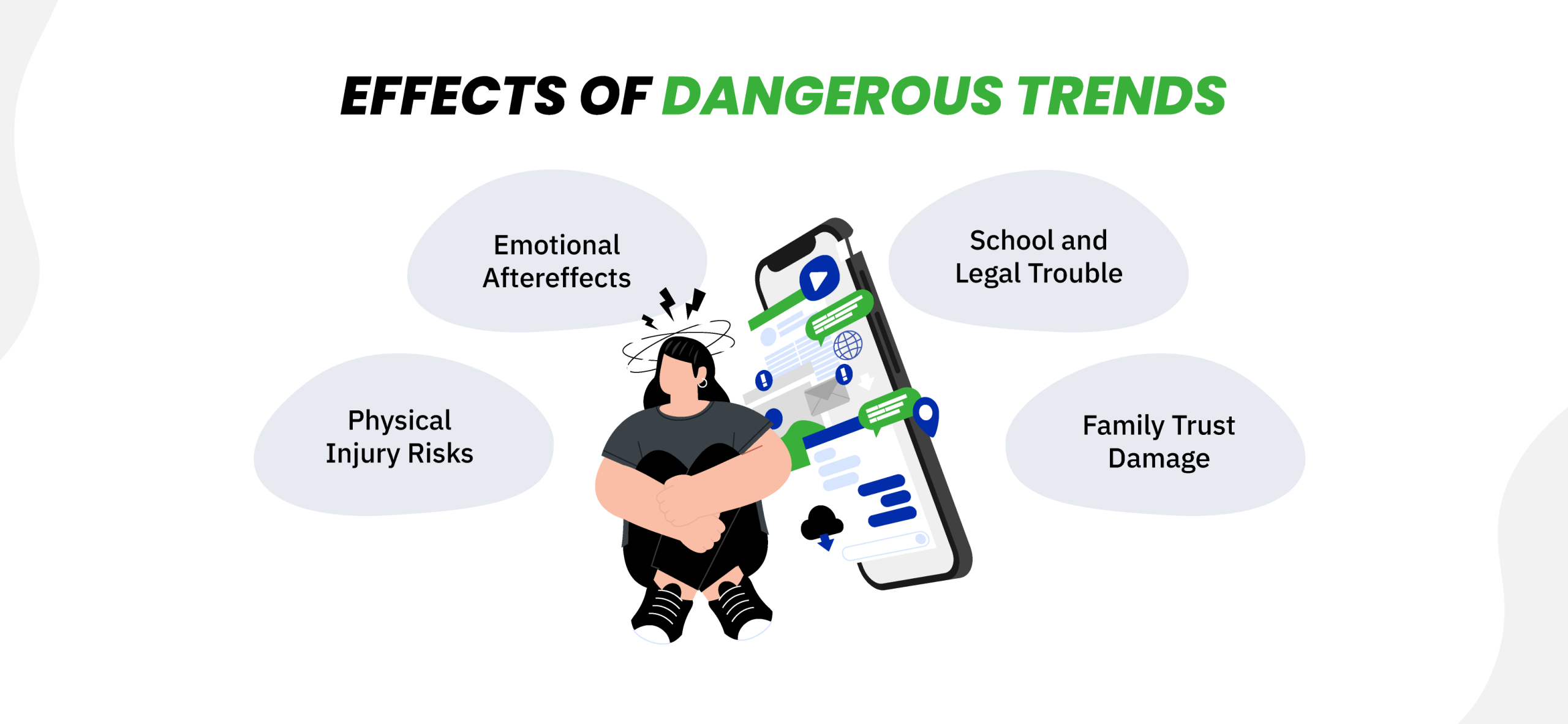
The dangers of social media challenges are not limited to the moment captured on camera. In many cases, harm can continue through recovery, school discipline, legal proceedings, shame, unwanted publicity, and family conflict.
Physical Consequences
Risky challenges have been linked to burns, poisoning, choking, lung damage, fractures, head injuries, seizures, and heart complications. In some cases, the incidents even require emergency treatment, surgery, rehabilitation, or ongoing medical care.
Psychological Consequences
The emotional effects of a challenge may continue long after it ends. A teenager may experience embarrassment, anxiety, guilt, or fear.
Legal and School Consequences
Some challenges cross the line from poor judgment into unlawful behavior. Pranks involving threats, trespassing, property damage, strangers, replica weapons, or emergency services can lead to suspension, arrest, fines, restitution, or civil claims.
Remember, claiming that an incident was “just a prank” or created for social media does not remove responsibility.
Family and Social Consequences
Viral risk-taking can also damage trust between teenagers, parents, friends, and schools. Parents may feel pressured to impose strict restrictions, while teens may become defensive or hide more of their online activity.
Clear consequences may be necessary, particularly when someone has been injured or endangered.
Why Your Teen Might Participate
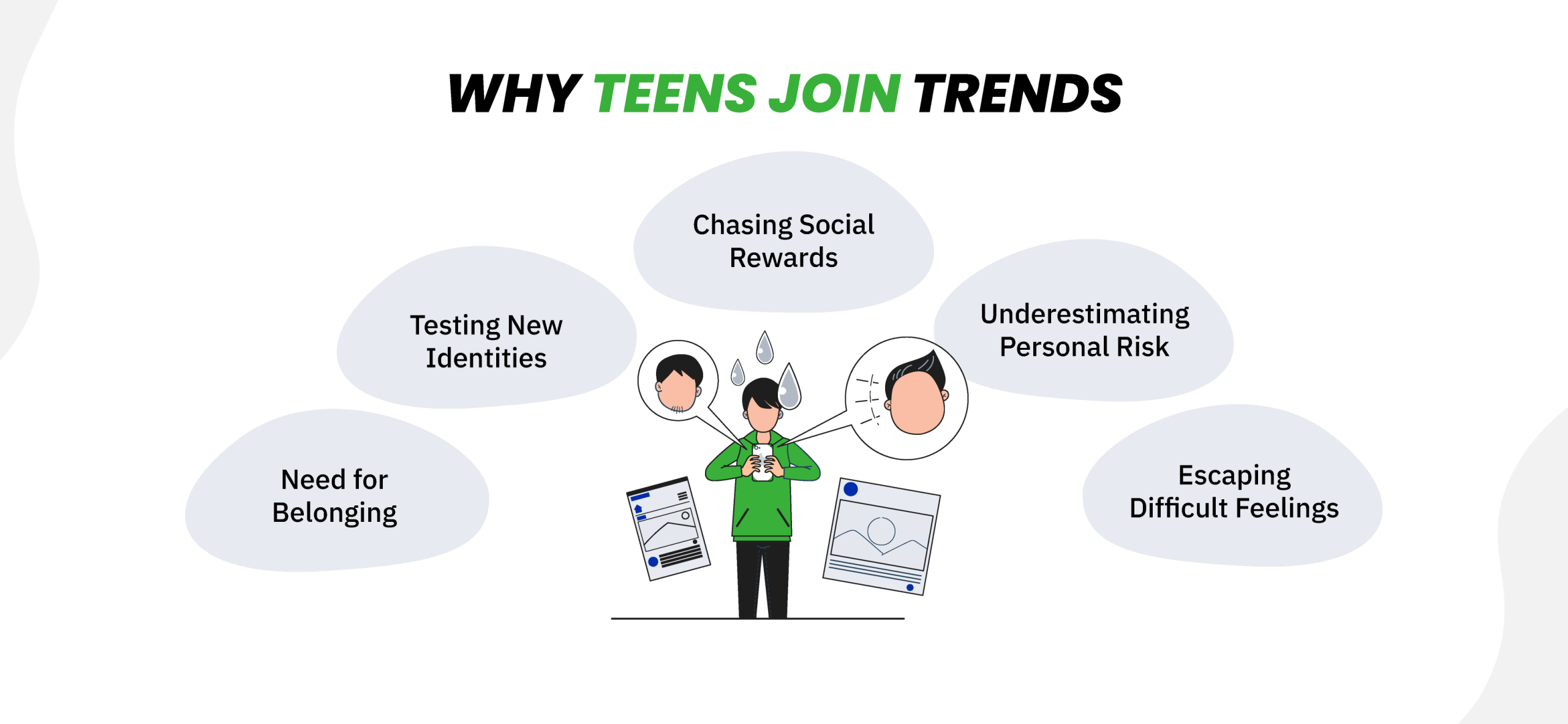
Understanding dangerous challenges on social media is easier when parents separate motive from outcome. A harmful decision may be driven by an ordinary developmental need.
1. Belonging
For adolescents, social exclusion can feel intensely threatening. Therefore, joining the stunt may function as proof that they are part of the group.
2. Identity Testing
Teenagers try on identities like athlete, comedian, risk-taker, beauty expert, loyal friend, fearless creator, etc. So, a challenge offers a fast public performance of that identity.
3. Reward Sensitivity
Adolescent decision-making is strongly influenced by immediate social rewards. As a result, the possibility of likes, comments, reshares, or peer approval can feel more emotionally real than an injury that may happen later.
4. Optimism Bias
Young people may believe the injury happened because someone else was careless. Therefore, they assume their coordination, strength, or preparation will protect them.
5. Emotional Escape
Since risky behavior can interrupt boredom, loneliness, embarrassment, or low self-esteem, teens may use adrenaline and attention to temporarily replace uncomfortable feelings.
Six Ways to Reduce the Risk of Dangerous Online Challenges
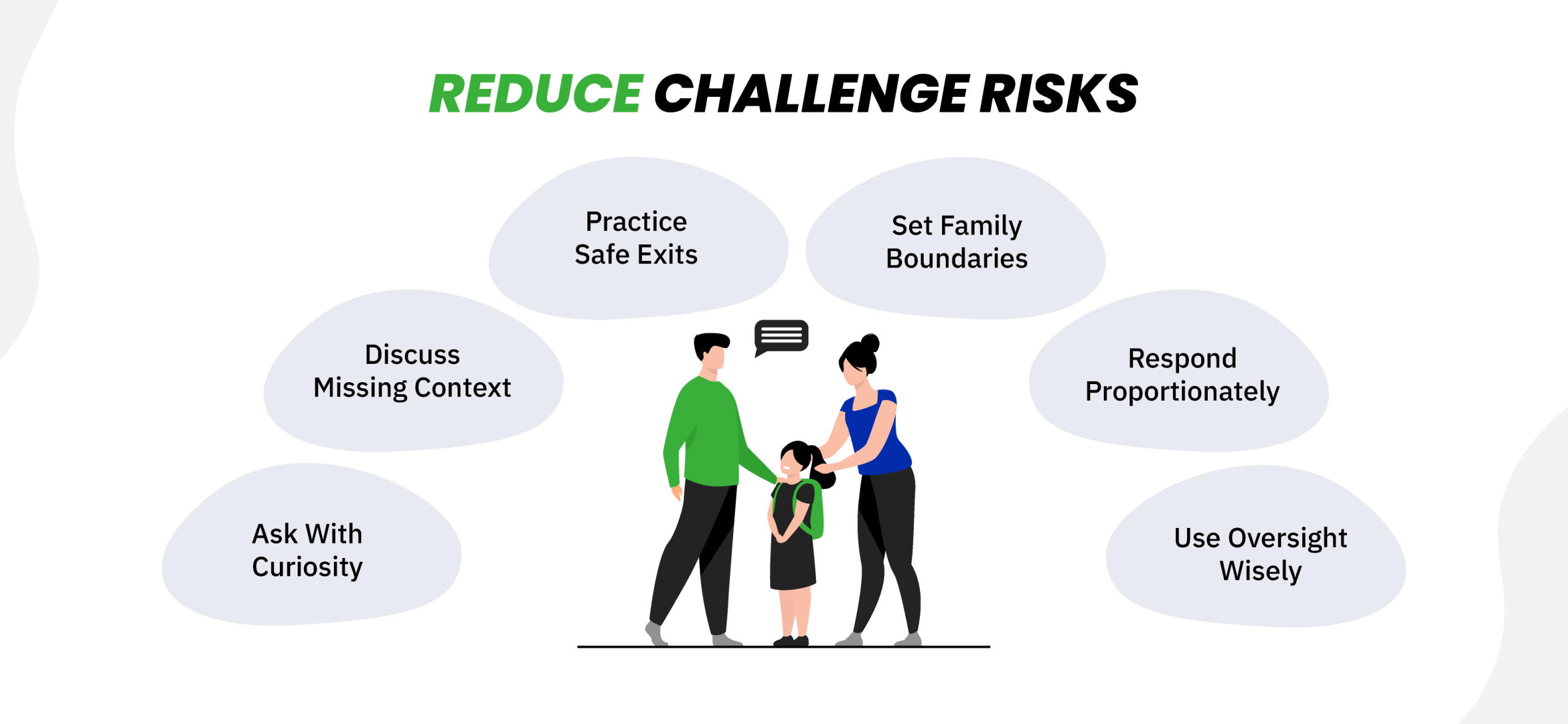
Parents cannot predict every trend, and chasing each hashtag is not a sustainable safety strategy. The stronger goal is to build a teenager’s internal pause between seeing and imitating.
1. Start With Curiosity
When parents try questions like “What are people at school saying about this?” or “What makes this video appealing?”, the curious opening produces more information than a statement like “You had better not be doing this.”
2. Discuss the Missing Footage
Ask what happened before and after the clip. Was there a failed attempt? Did someone need medical help? Was the video edited?
This is one of the clearest ways to teach the dangers of social media challenges without relying on fear.
3. Rehearse a Face-Saving Exit
Teenagers need language that protects social status. Therefore, teach them useful responses like:
- I’m not getting injured for somebody else’s post.
- My coach would bench me if I did that.
- Delete my face from that video.
4. Create Clear Family Boundaries
A family media agreement can prohibit content involving restricted breathing, medication misuse, inhalants, weapons, fire, trespassing, strangers, nonconsensual filming, and deliberate injury.
5. Respond Proportionately
A minor judgment error and a life-threatening act should not receive the same response. Immediate medical or legal risks require firm intervention, while lower-level incidents may be better addressed through education and changed access.
6. Use Oversight to Support Conversation
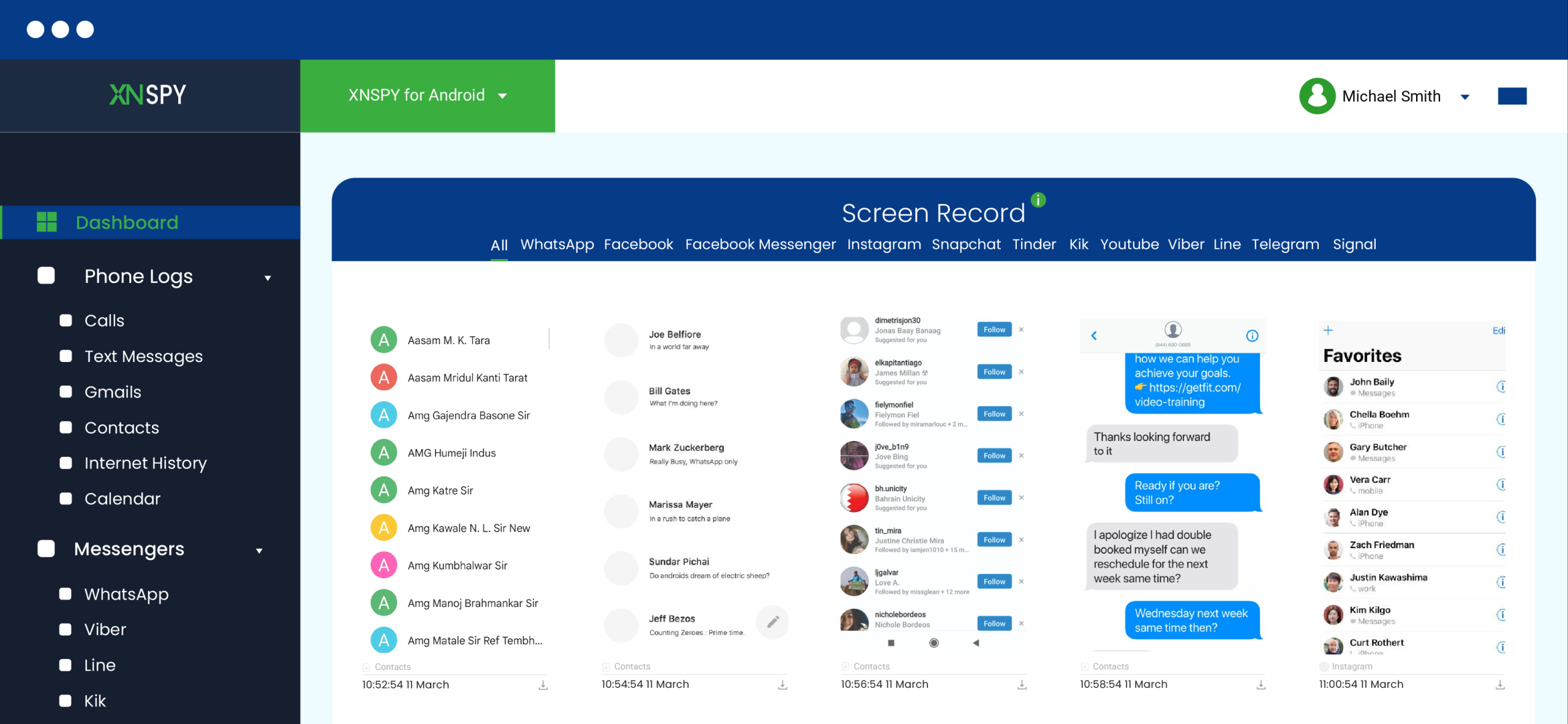
Age-appropriate oversight can help parents notice sudden changes in online interests and exposure.
Xnspy can be a part of a family-safety approach that enables parents to get better visibility into their kids’ online activities and trend participation patterns.
Features like screen recorder, keylogger, social media chats, and screen time can be helpful in identifying concerning digital activities while supporting healthy conversations.
Remember, the aim is not to know every video your child sees. It is to ensure that when they appear, your child already has the judgment and confidence to step away.
Conclusion
Online dares evolve quickly, but adolescents’ needs change much more slowly. Belonging, recognition, identity, curiosity, and independence are the forces beneath many dangerous trends on social media.
Parents are, therefore, most effective when they combine accurate information with emotional steadiness.
Remember, the strongest protection against these challenges is not monitoring alone. It is a teenager who can recognize manipulation, tolerate the discomfort of saying no, and trust that a parent will listen before reacting.
FAQs
How many teens engage in dangerous challenges on social media?
There is no reliable worldwide percentage for the number of teens partaking in dangerous trends. However, what research does confirm is that some challenges have caused serious injuries and deaths.
Are social media platforms doing enough to stop risky challenges?
Most major platforms have rules against content that encourages dangerous behavior, self-harm, or illegal activity. Therefore, they may remove videos, restrict searches, display safety warnings, or reduce a post’s visibility. However, moderation is not always fast enough to stop a trend before it spreads.
Which age group is most vulnerable to participating in social media dangerous challenges?
Early and middle adolescents may be particularly vulnerable because fitting in and gaining peer approval can strongly influence their decisions. They may understand that an activity is risky but still underestimate how easily something can go wrong.
How can I warn my child without making the trend more interesting?
You can start by asking what your child has already heard or seen. Then explain the main danger in clear language and discuss how online videos can hide failed attempts, injuries, or emergency treatment.
Why do social media challenges return after disappearing?
Old challenges often return with a new name, soundtrack, hashtag, creator, or variation. Therefore, a stunt that seems new to one group of teenagers may actually be a recycled trend from several years earlier.
This is why parents do not need to memorize every trend. Instead, teaching children to question the risks and possible consequences of any online dare offers more lasting protection.

4 Comments
Leave a reply:
Your email address will not be published. Required fields are marked*


Honore Couture
August 13, 2025 at 3:05 pmCan we not just ban social media for everyone? This is becoming increasingly concerning
Bryan Steve
August 19, 2025 at 2:50 pmCan we not just ban social media for everyone? This is becoming increasingly concerning
Senorita
August 22, 2025 at 3:00 pmThese social media challenges are really getting out of hand
Lucy James
September 5, 2025 at 2:29 pmI have tried that!